Posts

Showing posts with the label Ukraine

001bis. Marusja Čuraj / Маруся Чурай

Image
Remember Marusja Čuraj , the legendary folk heroine who was the subject of our first post? Her reputation in Ukrainian literature and culture would seem to be based upon the enormous popularity that she garnered in the romantic era when Marusja was featured in several literary works, including a tale in Ukrainian by H. F. Kvitka-Osnovjanenko (1834) and one in Russian by A. A. Šachovskoj (1839). Marusja was also the subject of a children's story authored by the well-known woman writer "Marko Vovčok" (a pseudonym for Marija Aleksandrovna Markovič, née Vilinskaja, 1833-1907). Her tale, entitled "Marusja" (1871) was widely translated. This is the  cover of the French edition  (1878) – from which Vovčok's own name was omitted! O, students , so many projects come to mind! Why not research the context of this story's writing and publication , for example? Was it really written in Paris in the 1860s – and in Ukrainian – as alleged on the Ukrainian Wikip...
004n. Mavra Egorovna Šepeleva (Šuvalova) / Мавра Егоровна Шепелевa (Шувалова)

Image
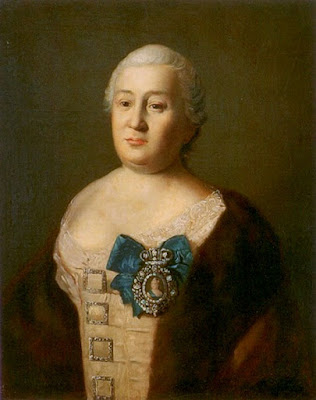
W hile we're on the subject of Anna Ioannovna , w e might as well pause for a moment to take note of Mavra Egor o vna Š epeleva (1 708 -17 59 ), who would seem to be the next woman writer in order of birth date, although she has largely fallen between the cracks of literary history. Š epeleva is not mentioned in Golicyn , for example ( which I ' ve indicated by adding an "n" for "new" to her number ) , but she does appear a s the chronological successor to Natal'ja Alekseevna in Lurana O'Malley's review of eighteenth-century women 's dramaturgy (1 7 ) . Š epeleva left a more evident trace in socio - political h istory: her prominent career in elite circles began in 1719 with her appointment to the retinue of Anna Petrovna, a distant relation of Anna Ioannovna and daughter of Peter the Great . Most important , however, was Š epeleva ' s intimate friendship with Anna Petrovna ' s sister, Elizaveta Petrovna , who became Russi...

001. Marusja Čuraj / Маруся Чурай

Image
According to Prince N. N. Golicyn  (272-73), the first Russian woman writer was Marusja Čuraj.[1] Marusja, whose creative talents flourished in the midst of 17th-century struggles for independence, has since become a Ukrainian folk heroine; in 2000, she was featured on a Ukrainian postage stamp:[2] In Golicyn's synopsis, Mar'ja Gordeevna "Marusja" Čuraj was born in Poltava in 1628 and died at some point after 1648. She was "the daughter of a Cossack officer of the Poltava regiment, who was burnt at the stake in Warsaw" and though sentenced to death herself in 1648, she was subsequently pardoned, the story goes, "for the sake of her sweet songs". In short, Marusja was an "improvisor of Ukrainian songs and one of the best singers in Ukraine at that time". Golicyn goes on to list the titles of six of her songs, some of which are in Ukrainian and some in Russian. Golicyn's sources are three: (1) "Marusja Čuraj, Malorussian ...